

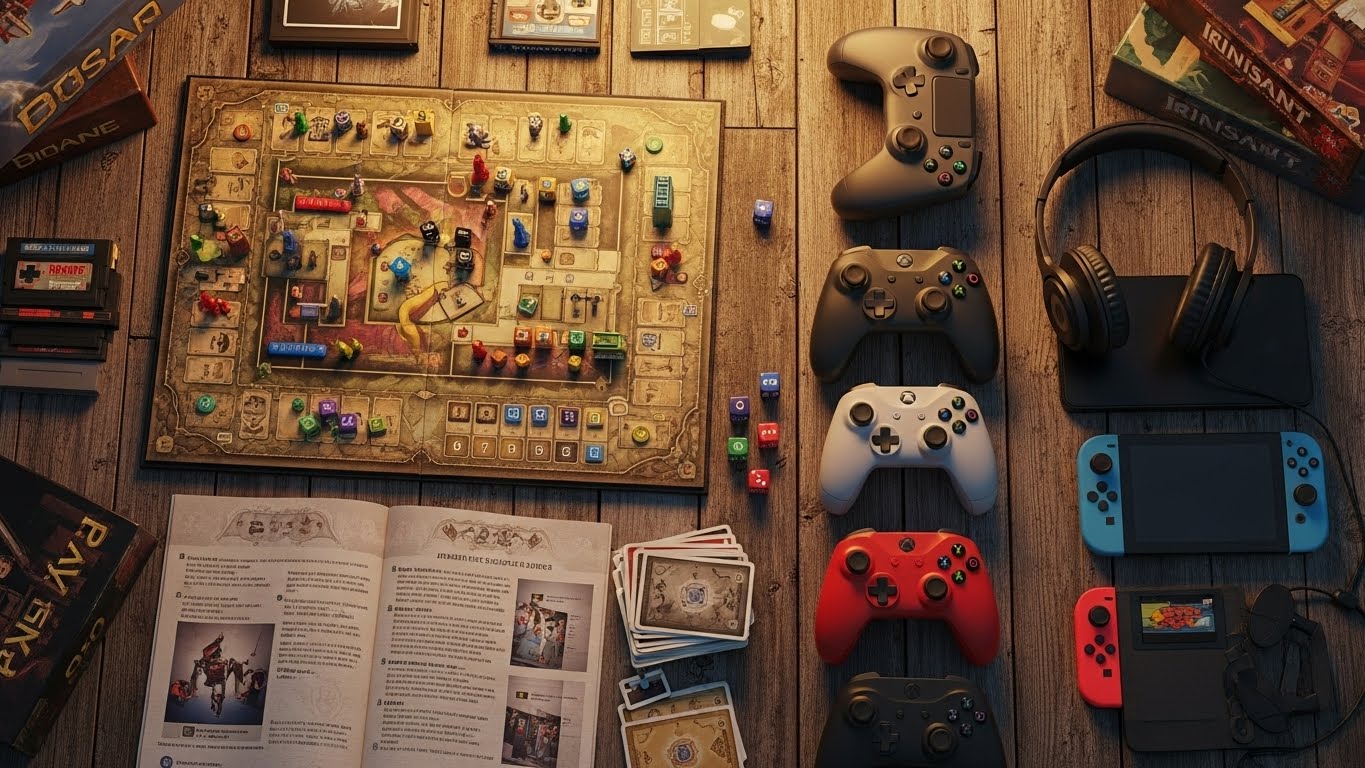
The world of gaming has undergone an incredible transformation over the past few decades. What started as simple pixelated adventures on home consoles has evolved into immersive, lifelike experiences with interactive narratives, expansive open worlds, and ever-growing communities. Gaming today is not just a pastime, but a global cultural phenomenon that touches on everything from art and technology to social dynamics and personal identity. This blog takes a deep dive into the evolution of gaming, exploring its humble beginnings, explosive growth, and where it’s headed in the future.
The Humble Beginnings: The Birth of Video Games
The story of video games begins in the 1950s and 1960s when computing technology was still in its infancy. Early games were often simple experiments created by scientists and engineers working with massive computers. One of the first notable games, Tennis for Two (1958), was created by physicist William Higinbotham on an oscilloscope, marking one of the earliest attempts at interactive entertainment. Soon after, the game Spacewar! (1962), developed by Steve Russell and others at MIT, became one of the first video games to gain widespread popularity within the tech community.
However, it wasn’t until the 1970s that video games began to take their first steps into the public consciousness. Pong (1972), developed by Atari’s Nolan Bushnell, became the first commercially successful arcade game. Its simple, yet addictive gameplay—where players control paddles to bounce a ball back and forth—captured the attention of millions and set the stage for the video game revolution.
The Rise of Home Consoles: Gaming Goes Mainstream
By the late 1970s and early 1980s, video games were no longer confined to the arcades. The first generation of home consoles, such as the Atari 2600, made gaming accessible to households around the world. The Atari 2600 introduced the idea of interchangeable game cartridges, allowing players to experience a variety of games on a single console. This move marked the beginning of gaming as an entertainment industry in its own right.
The early 1980s were a golden age for home consoles, with titles like Space Invaders, Pac-Man, and Donkey Kong becoming cultural touchstones. These simple yet engaging games captured the imagination of children and adults alike. However, the rapid growth of the industry led to an eventual crash in 1983, primarily due to over-saturation in the market and a flood of low-quality games.
Despite this setback, the video game industry rebounded in spectacular fashion, largely thanks to the release of the Nintendo Entertainment System (NES) in 1985. Nintendo’s well-curated selection of high-quality games, including classics like Super Mario Bros., The Legend of Zelda, and Metroid, helped revitalize the gaming market and introduced a new era of sophisticated, story-driven experiences.
The 3D Revolution: Entering the Third Dimension
The 1990s brought about one of the most significant milestones in the history of gaming: the transition from 2D to 3D graphics. With the release of consoles like the Sony PlayStation, Nintendo 64, and Sega Saturn, gamers were suddenly thrust into a world where depth, perspective, and dynamic environments were the new standard. Games like Super Mario 64, Final Fantasy VII, and GoldenEye 007 became iconic not just because of their gameplay, but because they introduced an entirely new way of experiencing virtual worlds.
The PlayStation, in particular, was a game-changer. With its 32-bit architecture and CD-based media, it allowed developers to create more detailed and expansive worlds, compared to the cartridge-based systems of the past. Final Fantasy VII, for example, was one of the first games to feature full-motion video sequences, which enhanced the storytelling experience. These advances helped gaming shift from a purely gameplay-driven experience to one that could also deliver complex narratives and emotional depth.
The shift to 3D also paved the way for the rise of open-world games, where players were given the freedom to explore vast virtual landscapes. Titles like The Legend of Zelda: Ocarina of Time and Grand Theft Auto III pushed the boundaries of what was possible in terms of scale and interactivity. Players could now roam around expansive worlds, interact with various characters, and choose their own path through the story.
The Online Revolution: Gaming Becomes Social
As the 21st century arrived, the gaming landscape underwent another dramatic transformation—this time driven by the rise of the internet. Broadband connections and online multiplayer functionality began to reshape how people played and interacted with games. The concept of online gaming became a global phenomenon, with millions of players across the world connecting to virtual worlds, battling against one another, and cooperating on epic quests.
The early 2000s saw the rise of online multiplayer games like Halo 2, World of Warcraft, and Counter-Strike. These games took the cooperative and competitive elements of gaming to new heights, creating massive, interconnected communities. For the first time, players no longer had to be in the same room to enjoy a game together—they could connect with friends and strangers across the globe, forging new relationships and rivalries in virtual spaces.
The PlayStation Network and Xbox Live services also played a key role in expanding the online gaming experience. With these platforms, players could download games, access downloadable content (DLC), and communicate with others through voice chat, messaging, and party systems. The social aspect of gaming became as important as the gameplay itself, as online communities grew around games, with forums, fan sites, and video tutorials becoming essential parts of the experience.
The Rise of Mobile Gaming: Games in Your Pocket
As smartphones became an essential part of daily life, mobile gaming quickly emerged as a dominant force in the industry. Games like Angry Birds, Candy Crush Saga, and Clash of Clans made gaming more accessible than ever before, allowing players to enjoy casual gaming experiences during commutes, while waiting in line, or even while watching TV. The convenience of being able to game on the go, combined with the rise of microtransactions, turned mobile gaming into a billion-dollar industry.
Mobile gaming opened up a new demographic of players who may have never considered gaming on consoles or PCs. With the free-to-play model, players could download games for free and pay for in-game items or progress through microtransactions. While this model has been met with mixed reactions from some traditional gamers, it has undeniably expanded the audience for video games, introducing gaming to people of all ages and backgrounds.
The Role of Streaming and eSports
The rise of streaming platforms like Twitch and YouTube has transformed gaming from a solo activity into a spectator sport. Watching others play games has become a massive form of entertainment, with professional gamers, influencers, and streamers drawing millions of viewers. League of Legends, Fortnite, and Dota 2 have become household names, not just for their gameplay but for the entertainment value of watching professional tournaments.
eSports, or competitive gaming, has become a global industry in its own right, with players competing for large cash prizes, sponsorships, and recognition. Games like Overwatch, Counter-Strike: Global Offensive, and Call of Duty have given rise to professional leagues and tournaments that attract millions of viewers worldwide. The rise of eSports has also helped elevate gaming as a respected form of entertainment, with professional gamers now seen as athletes in their own right.
Streaming platforms have also introduced new ways for players to engage with games. Fans of Minecraft, for example, can watch live streams of their favorite players creating impressive structures or participating in community challenges. The interactive nature of streaming allows viewers to influence gameplay through donations, tips, and comments, creating a sense of community and participation that goes beyond traditional forms of media.
The Future of Gaming: Virtual Reality and Beyond
Looking to the future, gaming is poised to continue evolving in exciting ways. Virtual reality (VR) and augmented reality (AR) are two technologies that are beginning to shape the next generation of gaming. VR offers players a completely immersive experience, where they can physically move through virtual worlds, interact with objects, and engage in combat or exploration in ways never before possible. Games like Half-Life: Alyx have shown just how immersive VR can be, and as the technology becomes more affordable and accessible, we can expect a wave of new VR titles to hit the market.
In addition to VR, the use of AI in gaming is likely to revolutionize the industry. Games powered by advanced AI could feature highly intelligent non-playable characters (NPCs) that learn from player behavior and adapt accordingly, creating a more dynamic and unpredictable gameplay experience. The integration of machine learning could also enable game worlds to evolve based on player choices, offering an unprecedented level of customization and interactivity.
Cloud gaming, powered by services like Google Stadia and Microsoft’s Xbox Cloud Gaming, is also changing the way people access and play games. With cloud gaming, players no longer need high-end hardware to run the latest games—they can stream them directly from servers in the cloud. This technology makes gaming more accessible to a broader audience and eliminates the need for expensive consoles or PCs.
Conclusion: Gaming as an Art Form
What began as a simple form of entertainment has evolved into a diverse, multifaceted industry that encompasses art, storytelling, social interaction, and technological innovation. Today, gaming is a medium capable of telling complex narratives, creating vast interactive worlds, and bringing people together in ways that were unimaginable just a few decades ago. As technology continues to advance, the future of gaming looks brighter than ever, with new possibilities on the horizon that will continue to captivate and inspire players around the world.